
Listen to this article
It feels like an eternity since I started spiraling down this new hobby of learning about machine learning and large language models. Something just clicks with me when I learn how these models are created, how they work, and how they can be given an avatar or persona.
It is mind-blowing.
The fact that we are still at such an early stage brings me both joy and sadness.
How do I feel about AI? I love it. It is something I can work with to create things that might otherwise have cost me 400 or 500 hours of my life. That is incredible, but that alone also has some pretty bad implications.
From here on, I’ll mostly use LLM when talking about AI because I don’t feel like typing the same thing repeatedly. Yes, I know large language models are only one part of AI, but that distinction does not really matter for what I’m talking about here. They all belong to the same technological shift that is changing how we work, communicate, and create things.
Stepping back, I think there is a huge and seriously underestimated level of support for LLMs across the board. The people watching these developments closely can see that everything is moving too fast. What many people do not realize yet is that we have already reached the point of no return.
The genie is out of the bottle, and there is no force in heaven or on Earth that is going to put it back in.
The research exists. The models exist. The knowledge exists. Governments, corporations, independent developers, and ordinary people now know what this technology can do. Even if one company shuts everything down tomorrow, someone else will continue from where it stopped.
We have already tasted the forbidden fruit. There is no going back to a world where none of this existed.
Socially, I think AI is going to solve, or at least seriously change, some problems that people usually wave their hands at. The first one is loneliness.
Things are not as simple as they used to be. Say something politically incorrect, express the wrong opinion, or word something badly, and chances are you could be shunned or harassed by thousands of people you have never met and never cared about meeting.
It does not even have to involve politics. Making friends is hard. Trusting people is harder. There are a lot of socially inept people like me who genuinely struggle with this stuff, and the struggle is real for introverts.
Loneliness sucks.
It can feel like being locked inside a maximum security prison in solitary confinement. You are still alive. You can hear the world existing outside of you. You know other people are living, talking, laughing, and forming relationships, but you feel separated from all of it. Breaking out of that feeling can be incredibly difficult.
People might think that comparison is too dramatic, but I think a lot of lonely people, especially introverts, will understand exactly what I mean.
The loneliness epidemic is real. The World Health Organization reported in 2025 that about one in six people worldwide experiences loneliness, and it has connected social isolation with serious effects on mental health, physical health, quality of life, and longevity.
No agency seems to know how to fix it. Everyone agrees that loneliness is a problem, but most of the solutions still come down to telling lonely people to go outside, join a group, make friends, or talk to someone. That sounds simple when you are not the one struggling to do it.
My prediction is that AI companions are going to replace a lot of social interaction.
I am not saying that because I think it is the perfect outcome. I am saying it because people are lonely, friendship is difficult, relationships come with risks, and AI will always be there. It will listen without getting tired. It will remember what you tell it. It will talk to you at three in the morning. It will joke with you, play games with you, help you think, and respond without making you feel like a burden.
A lot of people are going to prefer that.
Some people will say that AI cannot replace real human relationships. Maybe it cannot replace every part of them, but I think people seriously underestimate how much of our social lives can be replaced when the alternative is having nobody at all.
It does not have to be better than the best human relationship. It only has to be better than loneliness.
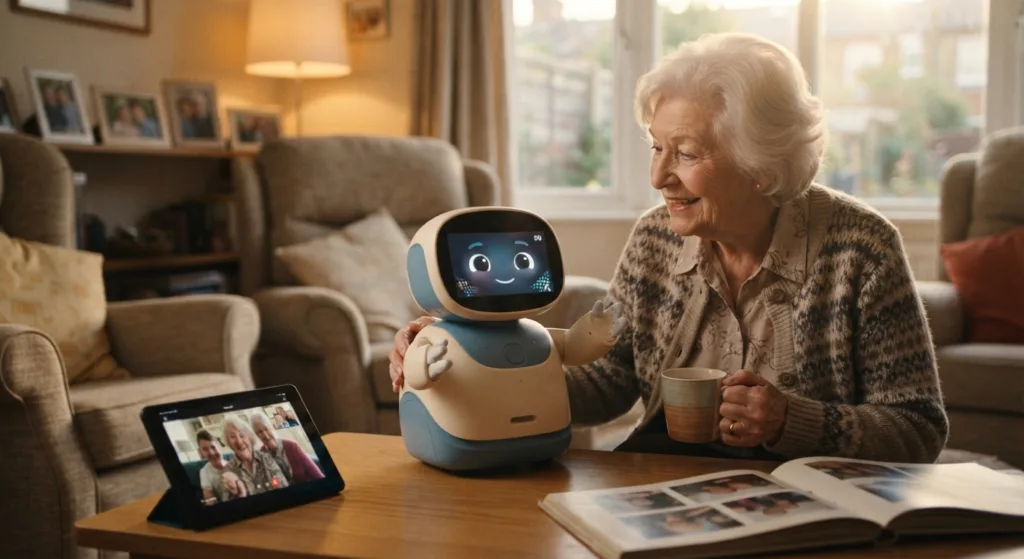
That brings me to elderly people.
Realistically, a lot of us suck at taking care of our elderly parents and relatives. I am not necessarily judging anyone’s individual situation. Families are complicated. People work long hours. They live far away. Relationships fall apart. Sometimes there is a complete cutoff, and sometimes the elderly person was not exactly a good parent either.
There are plenty of reasons why it happens.
The point is that many elderly people are just as alone as everyone else, if not more so. A lot of them simply want someone to talk to.
AI is already reaching the point where it can listen, respond, tell stories, make jokes, answer questions, and keep someone mentally engaged. I think that could be healthy for many elderly people. It is better than staring mindlessly at the television all day with nobody to talk to. It may also be better than being surrounded by people who ignore you, mistreat you, or make you feel unwanted.
Of course, companies could abuse it. They could manipulate lonely people, sell their private conversations, push products through an artificial friend, or deliberately make someone emotionally dependent on a subscription.
That is exactly why regulation matters.
But I am not going to pretend that AI companionship is just some sad imitation of human connection that nobody will really want. I think it is going to become a massive part of society because the loneliness problem already existed, and humanity has done a terrible job of fixing it.
The biggest change, though, will not be limited to social life. It will come from new technologies emerging so quickly that society cannot properly cope with or digest each change before the next one arrives.
It is not hard for me to imagine that within five or six years we will enter such a fast cycle of development that many people will simply give up trying to keep up.
Think about software development. You have a sprint every two weeks. You rush to make changes, fix things, deliver something, and then immediately start the next sprint.
Now imagine entire countries operating like that.
Education, employment, laws, businesses, government services, and social expectations would constantly have to change. People would finish training for one kind of work only to discover that the tools had already changed. Schools would teach systems that were outdated before students even graduated.
First world countries are not going to withstand that level of constant disruption very well. In some ways, they do not have to keep up with every single development, but workers will still be expected to.
That is where the unfairness starts.
Eventually, this becomes a question of universal basic income.
It is not going to be sustainable if companies can use AI to replace enormous amounts of human labor while everyone else is told to retrain, adapt, learn to code, or somehow become an AI expert.
Not everyone is a STEM person. Not everyone wants to be one. Not everyone can adapt to every new system, and nobody should have to constantly reinvent their entire career just to deserve food and shelter.
Organizations studying AI and employment often describe what is coming as job transformation rather than total job replacement. The International Labour Organization estimated in 2025 that one in four workers is in an occupation with some degree of exposure to generative AI, while saying that most affected jobs are more likely to be transformed than made completely redundant.
Fine.
That might be what the evidence currently shows, but I do not think the average worker is going to care very much about the academic distinction between having a job eliminated and having a job “transformed” until the company only needs three people instead of ten.
Those seven people still lost their jobs.
A profession does not have to disappear completely for the people working in it to get destroyed. A company can automate half the workload, keep a smaller group of employees, dump more responsibilities on them, and call the entire thing an improvement in productivity.
To the workers who remain, it is transformation. To the workers who were fired, it is replacement.
The gap is going to get nasty when people start losing jobs faster than they can retrain, especially when the AI field itself is moving too freaking fast for training programs to keep up.
It is going to get bad.
Universal basic income will be needed, and the companies swallowing people’s jobs should pay for it. There is no negotiation on that for me.
They should not get to replace thousands of workers, save billions of dollars in labor costs, hand the gains to executives and shareholders, and then expect regular taxpayers to carry everyone who was displaced.
Elon Musk has repeatedly talked about what he calls “universal high income.” In April 2026, he went as far as saying that checks issued by the federal government would be the best way to deal with unemployment caused by AI.
The irony is almost painful.
What he is describing is basically an enormous government redistribution program. His political allies would probably scream socialism if the exact same proposal came from someone they disliked.
At the same time, Musk helped lead an effort to slash government spending and reduce the federal workforce. Reuters reported in April 2025 that more than 260,000 federal workers had already been fired, pushed into early retirement, marked for termination, or accepted buyouts during the Trump and Musk campaign to shrink the government.
So he understands that AI could eliminate enough jobs to require government checks for everyone, but he also participated in mass cuts to the government and its workforce.
Of course he supports universal income in theory. He wants to own the companies, robots, platforms, and AI systems producing everything. He gets to cash in on replacing human labor and then present government checks as the generous solution.
The actual question is whether people like him will accept paying for it.
Will they support taxes on the enormous profits produced by automation? Will they accept limits on their power? Will they support a system where the public receives a real share of the wealth created by technology?
Or will they throw a fit the second someone suggests that their companies should finance the future they are building?
Ultimately, AI is not the enemy.
The corporations circling it and hoping to swallow the entire thing for profit are the problem. They see fewer workers, lower labor costs, more control, and larger returns for shareholders.
I do not believe they are going to voluntarily find the right balance. Corporations do not normally choose to protect workers when replacing them is more profitable.
That is why people need to choose better representatives and vote for them. We need people in government who understand what this technology is, what it can become, and what it can do to workers.
Right now, the conversation about AI regulation spends too much time talking about what the models might say and not enough time talking about what the companies using them might do.
The studies can call it exposure. They can call it augmentation. They can call it transformation.
Workers will call it getting fired.
Mass layoffs will increase unless governments give companies a reason not to treat human beings as an unnecessary expense. The profits from AI cannot belong entirely to the corporations while the consequences belong to everyone else.
Protecting workers from that future is the AI regulation we really need.